
Nine Facts About Space That Sound Impossible
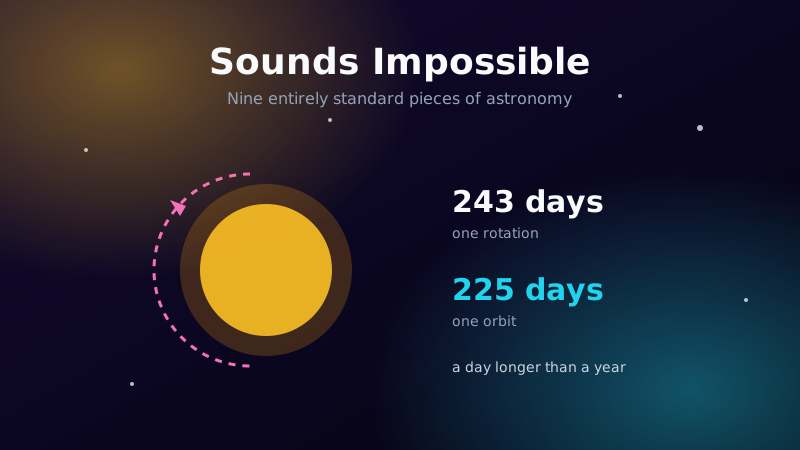
A planet where a day lasts longer than a year, a mountain three times the height of Everest, and a spoonful of star that weighs as much as a mountain range.
Space does not do moderate. Every one of these is standard astronomy.
1. A day on Venus is longer than its year
Venus turns so slowly that one rotation takes about 243 Earth days, while a trip round the Sun takes about 225. It also spins backwards compared with almost everything else in the solar system, so on Venus the Sun would rise in the west.
2. Saturn would float
Saturn's average density is about 0.69 grams per cubic centimetre, less than water. If you had a bath big enough, it would bob. It is also the least dense planet in the solar system by a wide margin.
3. A teaspoon of neutron star weighs about a billion tonnes
When a massive star collapses, its core can be crushed until a mass greater than the Sun's fits inside a sphere the size of a city. The material is so dense that a sugar-cube-sized piece would outweigh Mount Everest.
4. Olympus Mons is nearly three times the height of Everest
Mars has the tallest volcano in the solar system at about 22 km high and roughly the width of France. Its slopes are so gentle that standing on it you would not know you were on a mountain — the summit is beyond the horizon.
5. There are more trees on Earth than stars in the Milky Way
The galaxy holds somewhere between 100 and 400 billion stars. Earth has an estimated three trillion trees. There are, however, far more stars in the observable universe than grains of sand on Earth.
6. It rains glass, sideways, on HD 189733 b
This gas giant 64 light years away has an atmosphere thought to be full of silicate particles, a temperature over 900°C and winds around 7,000 km/h. The result, as far as the models go, is molten glass blowing horizontally.
7. The Moon is drifting away
Laser reflectors left by the Apollo missions let us measure it precisely: the Moon recedes by about 3.8 cm a year. Hundreds of millions of years from now, total solar eclipses will no longer be possible, because the Moon will be too small in the sky to cover the Sun.
8. Space smells of something
Astronauts returning from spacewalks consistently report a smell on their suits and tools — seared steak, hot metal, welding fumes. The leading suspect is atomic oxygen reacting on the surfaces, plus the by-products of broken molecules out there.
9. There is a hole in the universe with almost nothing in it
The Boötes void is a roughly spherical region about 330 million light years across containing only a few dozen known galaxies, where it should hold thousands. As the astronomer Greg Aldering put it, if the Milky Way had been in the middle of it we would not have known there were other galaxies until the 1960s.
Related: why Pluto stopped being a planet.