
Five Bits of Maths That Feel Wrong But Are Not
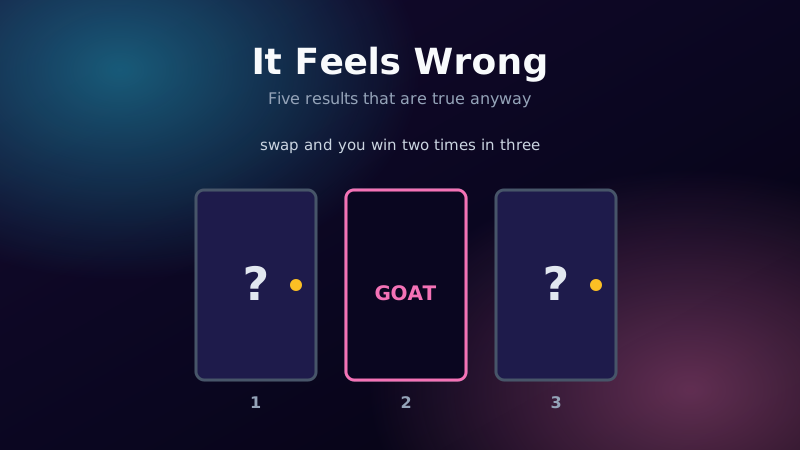
Why 23 people in a room is enough for a shared birthday, why you should always swap doors, and why folding paper 42 times would reach the Moon.
None of these is a trick. They are all straightforwardly true, and all of them feel like a con the first time you meet them.
1. Twenty-three people is enough for a shared birthday
With 23 people in a room, there is a better than even chance that two of them share a birthday. With 50 it is about 97%. It feels wrong because you picture your birthday against 22 others. The maths is counting pairs, and 23 people make 253 pairs. In a Premier League squad, a shared birthday is the likely outcome, not the coincidence.
2. You should always swap doors
Three doors, a car behind one, goats behind the other two. You pick a door. The host, who knows where the car is, opens a different door to show a goat, and offers you the swap. Swapping wins two times in three.
The reason is that the host's choice is not random. Your first pick is right one time in three, and in the other two cases the host is forced to show you the only remaining goat, so the car is behind the door he did not open. The puzzle generated sacks of angry letters from mathematicians when it was published in 1990, and they were wrong.
3. A chessboard of rice would bury the country
One grain on the first square, two on the second, doubling each time. By square 64 you need 263 grains, and the total for the board is about 18.4 quintillion — some two thousand times the world's annual rice harvest. The old story has the inventor of chess asking an emperor for exactly this and the emperor agreeing before doing the sums.
4. Forty-two folds reaches the Moon
A sheet of paper is about a tenth of a millimetre thick. Each fold doubles it. Ten folds is roughly the height of a person; 23 folds passes a kilometre; 42 folds is around 440,000 km, past the Moon. You cannot actually do it — the record is 13 folds, set by a class of American students with a very long roll of toilet paper — but the arithmetic holds.
5. An infinite hotel always has room
Imagine a hotel with infinitely many rooms, all full. A guest arrives. Move the guest in room 1 to room 2, room 2 to room 3, and so on for ever: room 1 is now free. An infinite coachload arrives. Move everyone to double their room number, and every odd-numbered room is free. Hilbert's hotel is the clearest demonstration that infinity is not a very big number and does not behave like one.
If you want the practical version of this, our piece on memory tricks that actually work covers the same ground for quiz night.