
Six Ways Your Senses Are Quietly Lying to You
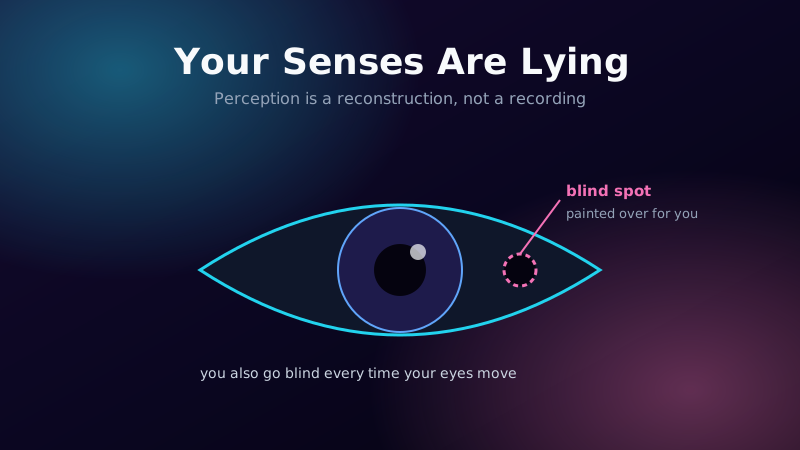
There is a hole in your vision you never notice, your eyes go blind every time they move, and what you hear changes depending on what you are looking at.
Perception is not a recording. It is a running reconstruction, and the gaps get filled in without telling you.
1. You have a blind spot in each eye
Where the optic nerve leaves the retina there are no light receptors at all, which means a patch of each eye's view is simply missing. You never see it, because the brain paints over it using the surrounding pattern. Close one eye, hold a finger out to the side and move it slowly across your view and you can find the point where it vanishes.
2. You go blind every time you move your eyes
Your eyes dart between fixed points several times a second, and during each dart the visual input is a smear. The brain discards it — saccadic masking — and stitches the stable images together, stretching the last one backwards to cover the gap. You lose a surprising fraction of your waking vision this way and never notice a flicker.
3. What you see changes what you hear
Play the sound "ba" over a video of someone mouthing "fa" and most people hear "fa". This is the McGurk effect, and knowing about it does not switch it off. Hearing is not a separate channel; it is merged with vision before you get a say.
4. You cannot tickle yourself
The cerebellum predicts the sensory consequences of your own movements and damps down the result, which is how you tell your own touch from someone else's. Tickling needs the surprise. The only reliable way round it is a mirror, a delay or someone else's hand.
5. The tongue map is nonsense
The diagram with sweet at the front and bitter at the back comes from a mistranslated German paper from 1901 and has been in textbooks ever since. All five basic tastes are detectable across the whole tongue. There are five, incidentally — sweet, sour, salty, bitter and umami, the last only accepted in the West in the 1980s.
6. Most of what you "see" is memory and guesswork
Only a small central patch of your vision is sharp — about the width of your thumbnail at arm's length. Everything else is low resolution and largely colour-blind at the edges, and the detailed world you experience is assembled from the last few glances. This is why change blindness works: in the classic experiments, people fail to notice the person they are talking to being swapped for someone else.