
Why Your Keyboard Says QWERTY
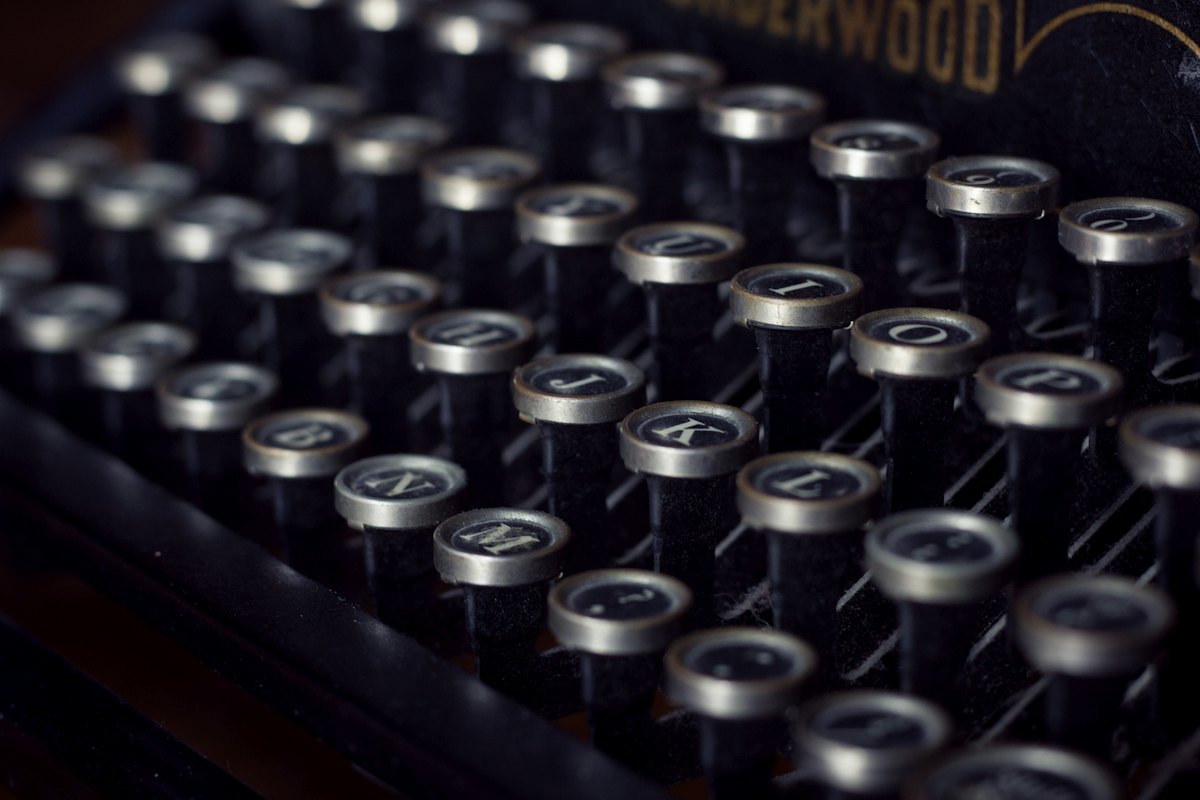
The layout was designed for a machine with physical levers that jammed. Why it survived the typewriter, whether Dvorak is really faster, and the "typewriter" row myth.
The letters on your keyboard are arranged in an order that made sense for a mechanical device nobody has used in decades. Here is how it happened and why it stuck.
The jamming problem
Christopher Latham Sholes built his first practical typewriter in the late 1860s with keys in alphabetical order. On those machines each key swung a metal typebar up to strike the paper. If two bars next to each other were struck in quick succession, they collided and jammed, and the typist had to stop and untangle them by hand.
Sholes rearranged the keys over several years so that letters frequently typed one after another in English sat far apart on the typebar basket, reducing collisions. The layout sold to Remington in 1873 is recognisably QWERTY.
The "it was designed to slow typists down" claim
This is half right in a way that is usually told wrong. The goal was never to slow the typist; it was to stop the machine jamming, which in practice let people type faster without stopping to fix it. The distinction matters, and the slowing-down version is repeated far more often than the truth.
The telegraph theory
There is decent evidence that early Morse telegraph operators influenced the layout too. They were among the first heavy users, transcribing Morse live, and some of QWERTY’s odder choices — the placement of Z and S, for instance — fit the ambiguities of American Morse better than they fit English letter frequency.
Why it survived
By the 1890s, typists had been trained on QWERTY in huge numbers, and schools taught touch-typing on it. Any manufacturer selling a different layout had to persuade buyers to retrain their entire typing pool. The layout outlived the mechanism it was built for because the cost of switching was carried by people, not machines — the textbook example of what economists call path dependence.
Is Dvorak actually faster?
August Dvorak patented an alternative in 1936, putting vowels and common consonants on the home row. Early US Navy studies reported large gains, but Dvorak himself was involved in running them, and later independent research has found differences small enough to be within the noise. Speed appears to depend far more on practice than on layout.
Colemak, a more recent design that keeps most keys where QWERTY has them, is the more popular alternative today precisely because it is easier to switch to.
The typewriter row
All the letters of "typewriter" appear on the top row — T, Y, P, E, W, R, I, T, E, R. It is widely claimed Sholes arranged this deliberately so salesmen could type the product name quickly. There is no contemporary evidence for it, and it is more likely a coincidence that was noticed afterwards and turned into a story.
Elsewhere in the world
- AZERTY in France and Belgium.
- QWERTZ in Germany and much of central Europe, where Z is common in German.
- QWERTY with modifications almost everywhere else, including the UK, where the only real differences from the US layout are the position of @, " and the £ sign.