
Why There Are Sixty Seconds in a Minute
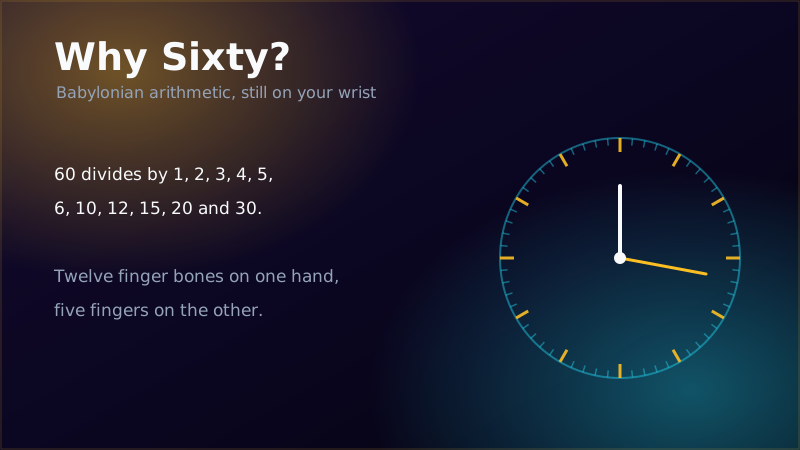
Everything else went metric. Time did not. The answer is Babylonian, involves counting on finger bones, and explains why a circle has 360 degrees too.
We measure almost everything in tens. Time is the glaring exception: 60 seconds, 60 minutes, 24 hours. The reason is about 4,000 years old.
The Babylonians counted in sixties
Sumerian and later Babylonian mathematics used a base-60 system, called sexagesimal. It was not arbitrary. 60 divides cleanly by 1, 2, 3, 4, 5, 6, 10, 12, 15, 20 and 30. For a civilisation doing arithmetic without decimal fractions, that is enormously convenient: a third of an hour is 20 minutes exactly, a quarter is 15, a fifth is 12. Try that with 100 and you get recurring fractions almost immediately.
How you count to sixty on two hands
There is a neat theory for where 60 came from. Each finger, excluding the thumb, has three segments — twelve on one hand. Use the thumb to tap each segment in turn and you count to 12 on one hand. Each time you reach 12, raise one finger on the other hand. Five fingers, twelve each: 60.
This also explains the stubborn persistence of 12 in English measurement: twelve inches, twelve pence in a shilling, twelve in a dozen.
How it reached the clock
The Egyptians divided day and night into twelve parts each, giving 24 hours. Greek astronomers, building on Babylonian records, needed finer divisions for their calculations and divided the hour into 60 partes minutae primae — "first small parts" — and each of those into 60 partes minutae secundae, "second small parts".
That is where the words come from. A minute is a minute, meaning tiny, division. A second is literally the second division.
Clocks could not measure anything that precise for centuries afterwards. Minute hands only became common in the 1600s, after the pendulum clock made them worth having.
And why a circle has 360 degrees
Same source. 360 is six sixties, divides by a great many numbers, and is conveniently close to the number of days in a year — so the sun moves roughly one degree along the ecliptic each day. Minutes and seconds of arc survive in navigation and astronomy for exactly the same reason they survive in time.
The attempts to change it
Revolutionary France introduced decimal time in 1793: ten-hour days, 100-minute hours, 100-second minutes. It required everyone to buy a new clock and think in unfamiliar units, and was abandoned within about eighteen months. A decimal calendar of twelve 30-day months plus five spare days lasted rather longer, until Napoleon scrapped it in 1806.
Metric time has been proposed repeatedly since and has never caught on. Sixty has survived every attempt to replace it — not because it is better in the abstract, but because changing it would mean changing every clock, every timetable and every habit at once.