
What Flags Are Actually Telling You
Crescents, crosses, stars, pan-African and pan-Arab colours. How to read a national flag you have never seen before, and the rules most of them follow.
Flags are not random. Once you know a handful of patterns you can make a decent guess at a flag’s region, and often its history, without recognising it at all.
The Nordic cross
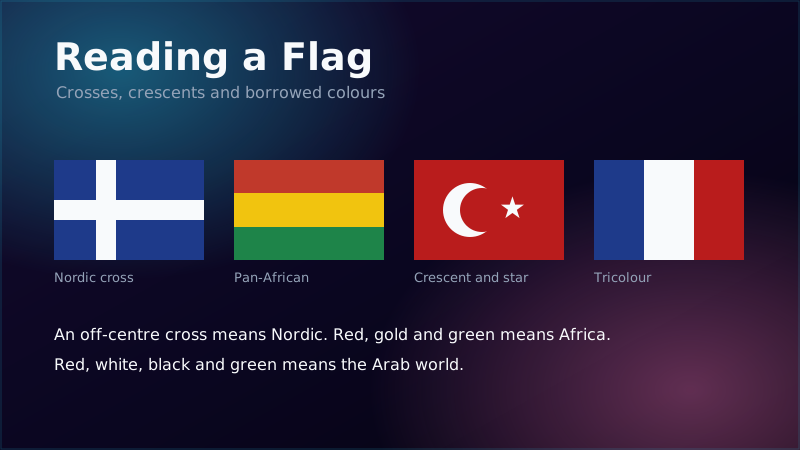
An off-centre cross, shifted towards the hoist, marks a Nordic country: Denmark, Sweden, Norway, Finland and Iceland, plus the Faroe Islands and Åland. Denmark’s Dannebrog is the original and is traditionally dated to 1219, making it the oldest continuously used national flag. Every other Nordic flag is a deliberate copy of its layout.
Pan-Slavic colours
Red, white and blue in horizontal bands runs through Russia, Serbia, Slovakia, Slovenia, Croatia and Czechia. The scheme was adopted at a Slavic congress in Prague in 1848, borrowing from the Russian flag, which had itself borrowed from the Dutch.
Pan-African colours
Red, gold and green — often with black — appear across Ghana, Senegal, Mali, Guinea, Cameroon, Ethiopia and many more. Ethiopia is the source: it was the African state that resisted colonisation, and newly independent countries adopted its colours deliberately. Red for blood shed, gold for mineral wealth, green for the land.
Pan-Arab colours
Red, white, black and green mark Jordan, Palestine, Kuwait, Sudan, the UAE, Iraq, Syria, Egypt and Yemen. They derive from the flag of the Arab Revolt of 1916, each colour representing a historic dynasty or era: black for the Abbasids, white for the Umayyads, green for the Fatimids, red for the Hashemites.
The crescent and star
Common across Muslim-majority countries — Turkey, Pakistan, Tunisia, Algeria, Malaysia, Azerbaijan. It is an Ottoman inheritance rather than a religious requirement, which is why many Muslim countries do not use it. Saudi Arabia instead carries the shahada in script above a sword, and because the text is sacred, the flag is never flown at half-mast.
The Union Jack in the corner
A canton with the Union Flag marks a current or former British territory: Australia, New Zealand, Fiji, Tuvalu, and various overseas territories. Distinguishing Australia from New Zealand is a standard quiz trap — Australia has six white stars including a large seven-pointed Commonwealth Star; New Zealand has four red stars with white borders.
The rules most flags follow
- Keep it simple enough for a child to draw from memory.
- Use meaningful symbolism rather than decoration.
- Use two or three basic colours.
- No lettering or seals, which are illegible at a distance and reversed on the back.
- Be distinctive, or deliberately related to a flag you share history with.
The ones that break the rules
- Nepal is the only non-rectangular national flag, two stacked pennants.
- Switzerland and Vatican City are the only two squares.
- Paraguay has different designs on each side.
- Mozambique carries an AK-47, the only modern firearm on a national flag.
- Belize has fifty-odd colours and two human figures, making it the most complex of all.