
What Those Bits of Everyday Objects Are Actually For
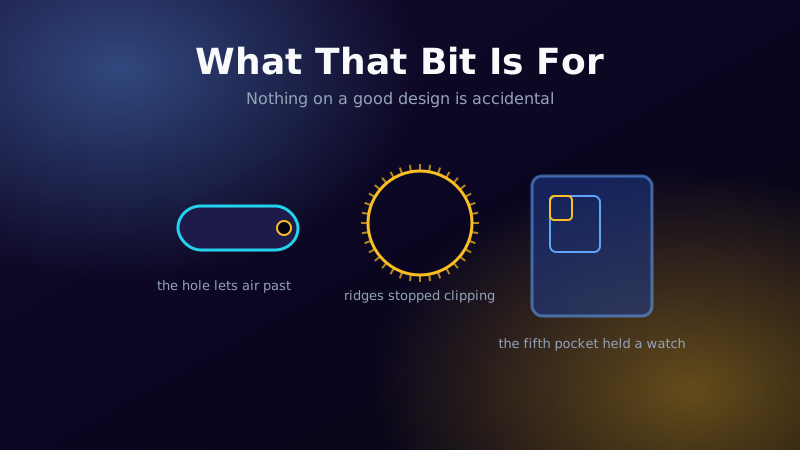
The hole in a pen lid, the tiny extra pocket on your jeans, the ridges on the edge of a coin, and the arrow next to your fuel gauge.
Designers rarely add anything for nothing. Here is what the odd bits are doing.
The hole in a biro lid
Partly to stop pressure building up and leaking ink, but mainly safety. Pen lids are a classic choking hazard for children, and the hole means that one lodged in a windpipe still lets air through. BIC has said explicitly that this is why it is there.
The tiny fifth pocket on jeans
It is a watch pocket. Levi's jeans from the 1870s were workwear, and a working man's watch was a pocket watch on a chain. Wristwatches took over after the First World War; the pocket stayed because the pattern did.
The ridges on the edge of coins
When coins were made of silver and gold, people shaved slivers off the edges and kept the metal — "clipping". Milled edges made it obvious. Isaac Newton, as Warden of the Royal Mint, pushed the recoining that stamped it out. The ridges survive on the 5p, 10p, 20p and 50p, and also help people who cannot see them tell one from another.
The arrow next to the fuel pump symbol
It tells you which side of the car the filler cap is on. Useful in a hire car, and worth knowing before you pull up at the wrong pump.
The loop on the back of a dress shirt
Called a locker loop. It comes from American navy uniform, so a sailor could hang a shirt up without a hanger, and was picked up by Ivy League students in the 1960s — who gave it a second life as a signal, since having yours torn off meant something about your relationship status.
The little plastic table in a pizza box
It keeps the lid off the cheese. It was patented in 1983 by Carmela Vitale and is formally a "package saver".
The hole in a pasta spoon
Two jobs. It lets water drain, and on many spoons it is sized to hold roughly a single portion of dry spaghetti.
The blue side of an eraser
Not for ink, whatever you were told at school. It is a coarser, grittier rubber meant for thick paper and heavier pencil marks — and on thin paper it mostly makes a hole.
The 57 on a Heinz bottle
Tap the raised 57 on the neck of a glass ketchup bottle and the sauce comes out. The number itself was invented — Henry Heinz liked the look of it and the company was already selling more than 60 products.