
The Tricks Crossword Setters Use Again and Again
Setters have a standard toolkit, and most of it repeats. The vocabulary they rely on, the misdirections they love, and the words that exist mainly to fit a grid.
Crossword setters are not trying to beat you. They are trying to beat you fairly, which means working within conventions you are expected to learn. Once you know the toolkit, half the fight is over.
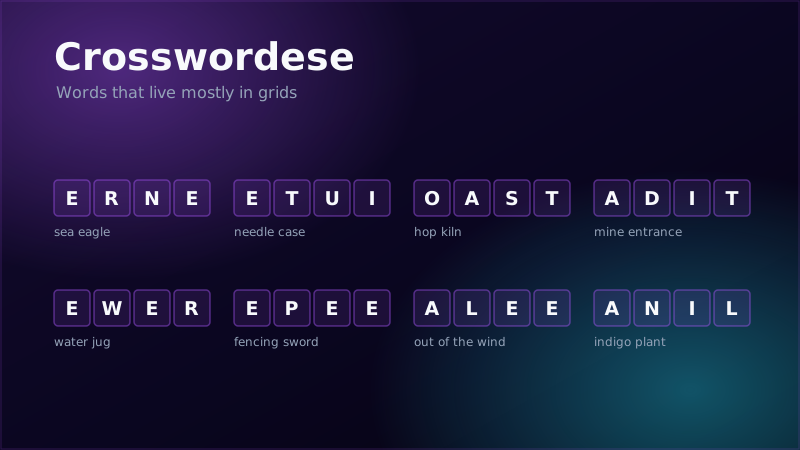
Crosswordese: words that live mostly in grids
Short words with awkward vowel patterns are gold to a setter and rare in ordinary life. You will meet these constantly:
| Word | Means |
|---|---|
| ERNE | Sea eagle |
| ADIT | Mine entrance |
| ETUI | Small needle case |
| OAST | Hop-drying kiln |
| ESNE | Anglo-Saxon labourer |
| ANIL | Indigo plant |
| EWER | Water jug |
| ORLE | Heraldic border |
| ALEE | Away from the wind |
| EPEE | Fencing sword |
| OLEO | Margarine |
| ASEA | At sea |
The misdirections
Capital letters that mean nothing. A clue starts with a capital because clues do, so "Bill" might be a duck’s beak, an invoice or a poster, not a man.
Words with two jobs. "Flower" is very often something that flows — a river. "Number" can mean something that numbs. "Second" can be a unit of time, a supporter, or the letter after the first.
Proper nouns hiding in plain sight. "Rose" as a past tense. "Reading" as a town. "Polish" as a nationality or a verb, depending on the capital letter you are not allowed to rely on.
Plural traps. A clue ending in S is not necessarily a plural — it might be the last letter of a charade.
Indicator words to recognise instantly
| Device | Typical signals |
|---|---|
| Anagram | confused, broken, cooked, drunk, strange, wild, out, poorly, novel, arranged |
| Reversal | back, up, returning, retreating, reflected, recalled |
| Hidden | in, some, part of, held by, a bit of, within |
| Homophone | we hear, said, reportedly, on the radio, aloud, spoken |
| Container | in, around, holding, eating, outside, embracing |
| Deletion | heartless, endless, beheaded, curtailed, topless |
| First letters | initially, firstly, leaders, at the start, heads of |
| Last letters | finally, ends, tails, at last |
The ones that catch everyone
- "Perhaps" or "say" or "for example" means the definition is a category, not the exact thing. "Dog, say" could clue SPANIEL or PET.
- "Nothing" is O. "Love" in a tennis sense is also O.
- "One" is I or A or AN.
- "The French" is LE, LA or LES. "The German" is DER, DIE or DAS. Setters love this.
- "Boxer" might be Ali, and a great many short clues are really asking for a famous three-letter surname.
- A question mark at the end is a warning: the clue is doing something cheeky, usually a pun or a definition that is stretched.
Why the same answers recur
A setter filling a grid needs words that interlock. Letters like E, A, R, S and T appear constantly because they are common in English, so answers rich in them fit more easily. That is why you meet ERNE and ETUI far more often in crosswords than in life, and why the same handful of rivers, Greek gods, musical notes and chemical symbols turn up week after week.
Which means learning them pays compound interest. The crosswordese above, plus the abbreviations setters assume, will unlock more clues than any amount of general knowledge.