
Roman Numerals, Explained Properly
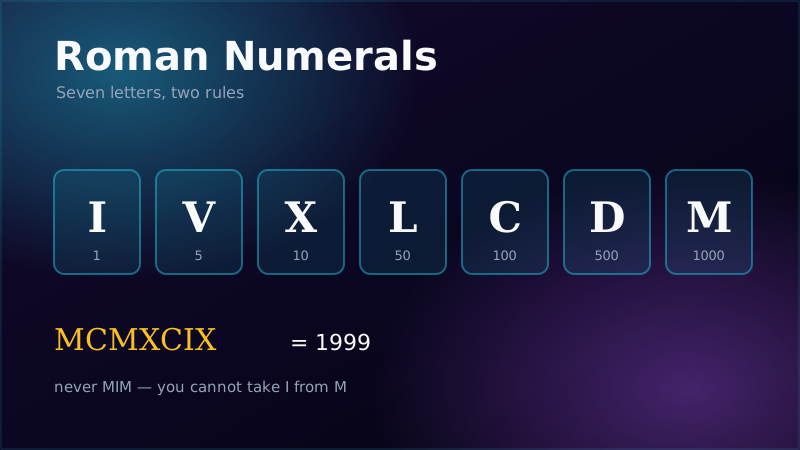
The seven letters, the subtraction rule, how to read a long numeral at a glance, and the years that trip people up — including why 1999 is not MIM.
Roman numerals turn up on clock faces, film credits, monarchs, Super Bowls and, constantly, in cryptic crosswords. The system is small enough to learn in ten minutes.
The seven letters
| Letter | Value |
|---|---|
| I | 1 |
| V | 5 |
| X | 10 |
| L | 50 |
| C | 100 |
| D | 500 |
| M | 1,000 |
A useful way to hold the order: I Value Xylophones Like Cows Dig Milk.
The two rules
Add when the letters descend. VIII is 5 + 1 + 1 + 1 = 8. LXX is 50 + 10 + 10 = 70.
Subtract when a smaller letter comes before a larger one. IV is 4, IX is 9, XL is 40, XC is 90, CD is 400, CM is 900.
Only six subtractive pairs are allowed: IV, IX, XL, XC, CD, CM. You may only subtract I from V and X, X from L and C, and C from D and M. That is why 1999 is MCMXCIX and never MIM — I cannot be subtracted from M.
Reading a long numeral
Work left to right in chunks, thousands first. Take MCMLXXXIV:
- M = 1000
- CM = 900 → 1900
- LXXX = 80 → 1980
- IV = 4 → 1984
Years people get wrong
| Year | Numeral |
|---|---|
| 1900 | MCM |
| 1944 | MCMXLIV |
| 1969 | MCMLXIX |
| 1999 | MCMXCIX |
| 2000 | MM |
| 2024 | MMXXIV |
| 2026 | MMXXVI |
The clock face oddity
Traditional clock faces print four as IIII, not IV. Nobody is certain why. The most likely explanation is visual balance — IIII on the left mirrors VIII on the right — and the habit simply stuck. Big Ben is a notable exception and uses IV.
Why crossword setters love them
Roman numerals let a setter smuggle letters into an answer. "Fifty" means L. "Hundred" means C. "Thousand" or "a grand" means M. "Five hundred" means D. "One" at the start of a word is very often I. If a clue mentions a number and the answer does not look numeric, this is almost always what is going on.