
How to Write a Quiz Round Worth Playing
The difference between a good question and a hard one. Pitching difficulty, ordering a round, writing plausible wrong answers, and the mistakes that lose a room.
Writing quiz questions is harder than it looks, and the common failure is not that questions are too easy or too hard. It is that they are not enjoyable to be asked.
A good question is one people enjoy getting wrong
That is the whole craft in a sentence. The best questions produce a groan and a "of course" when the answer comes, not a shrug. Aim for things people half know, where the answer is retrievable with effort.
A question nobody can get teaches nothing and flattens the room. A question everybody gets is a formality. The sweet spot is roughly 60 to 70% of the room getting it, with the rest kicking themselves.
Pitch it at what people have been exposed to
Not what they have studied. Most people have absorbed an enormous amount of information passively and have no idea they know it. The skill is finding the questions that unlock it.
"What is the capital of Burkina Faso?" tests whether somebody has memorised a list. "Which country's flag is the only one that is not rectangular?" tests whether somebody has ever looked properly at a flag. The second is a far better question and is not easier.
Order the round properly
Start easy. The first question sets the room's confidence for the whole round, and a team that gets question one wrong spends question two still arguing about it.
A reliable eight-question shape:
- Easy, to settle everyone.
- Easy.
- Medium.
- Medium.
- The hard one, placed where the room is warmed up but not tired.
- Medium, to recover.
- Something funny or surprising.
- Medium-hard, so the round ends on a real contest.
Writing the wrong answers
For multiple choice, the wrong options are where the quality lives. Three rules:
- Every option must be plausible. If one is obviously silly you have turned a four-way question into a three-way one.
- Keep them the same kind of thing. Four countries, four years, four people. Mixing categories gives the answer away.
- Keep them the same length. Players unconsciously pick the longest, most detailed option, because question writers unconsciously write it.
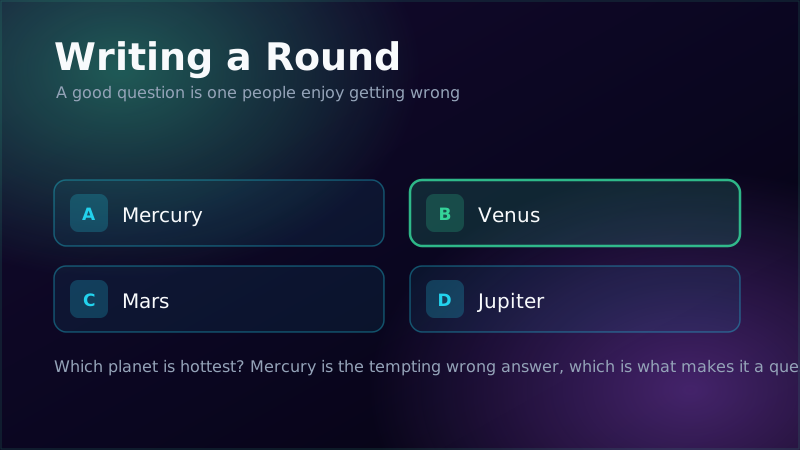
The strongest wrong answer is the one most people would give if you asked the question open — the common misconception. "Which planet is hottest?" is a good question precisely because Mercury is a tempting wrong answer.
Write the explanation, not just the answer
The ten seconds after the answer is read out is when people actually learn something, and it is the part most quizzes waste. "Venus, because a runaway greenhouse effect traps the heat, which is why it is hotter than Mercury" is worth four times "Venus".
The mistakes that lose a room
- Ambiguity. If two answers are defensible, you will spend five minutes arguing and someone will leave annoyed. Test every question on someone who was not in the room when you wrote it.
- Questions that are really about one hobby. A round of Premier League squad numbers is a specialist exam wearing a quiz costume.
- Too many dates. One year question per round. They are memory tests, not thinking.
- Burying the question. Put the thing being asked at the end, after the context, so people know what they are listening for.
- Not checking. Facts drift. Record-holders change, countries rename, "largest" and "first" claims get overtaken. Check anything superlative before you use it.