
How to Solve a Cryptic Crossword Clue
Every cryptic clue contains a definition and a piece of wordplay. Learn the eight clue types and the standard indicator words, and the whole thing opens up.
Cryptic crosswords look impenetrable and are not. They follow strict rules, and once you know them you are no longer guessing.
The one rule everything rests on
Every cryptic clue gives you the answer twice. Once as a straight definition, once as wordplay. The definition is almost always at the very start or the very end of the clue, never in the middle.
So the first move on any clue is to find where it splits. Read the first word or two as a definition, then the last word or two, and see which feels like it could define a word.
The eight clue types
1. Anagram. Signalled by a word suggesting disorder: confused, broken, mixed, cooked, drunk, out, badly, strangely, arranged.
Example: "Cheater, oddly, is an instructor" (7). The definition is "instructor" at the end. "Oddly" signals an anagram, and the fodder is CHEATER, which rearranges to TEACHER. Both halves land: TEACHER is an instructor, and its letters are those of "cheater".
2. Hidden word. The answer sits inside the clue, spanning words. Signalled by in, some, part of, held by, within.
Example: "Beginning found in lemon sets" (5). "Found in" signals a hidden word and "beginning" is the definition. Read straight across the letters: lemON SETs gives ONSET.
3. Reversal. The answer is another word backwards. Signalled by back, returning, up (in a down clue), reflected, going west.
Example: "Evil returning live" (4) → LIVE reversed is EVIL.
4. Charade. The answer is built from pieces joined in order, like charades.
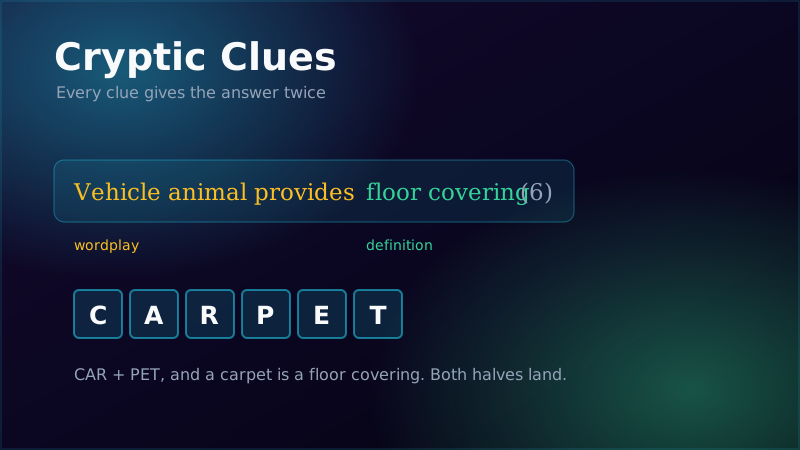
Example: "Vehicle animal provides floor covering" (6). Take the pieces in order: vehicle gives CAR, animal gives PET, and together they make CARPET, which is the floor covering.
5. Container. One word goes inside another. Signalled by in, around, holding, swallowing, eating, outside.
6. Deletion. Remove a letter. Signalled by heartless (lose the middle), endless / unfinished (lose the last), beheaded (lose the first).
7. Homophone. Sounds like another word. Signalled by we hear, reportedly, on the radio, said, aloud.
8. Double definition. Two meanings side by side, no wordplay at all. Usually a short clue of two or three words.
Example: "Left port" (4) → LEFT and port both mean the same side of a ship.
The abbreviations setters assume you know
| Clue says | You write |
|---|---|
| Learner, student | L |
| Doctor | MD, DR, MO |
| Queen | ER, R |
| King | K, R |
| Gold | OR, AU |
| Silver | AG |
| Iron | FE |
| Fifty / hundred / thousand | L / C / M |
| Note | A–G, DO, RE, MI, TE |
| Sailor | AB, TAR, SALT |
| Point | N, S, E, W |
| About | RE, CA, C |
| Very | SO (in music, F for forte) |
| River | R, or EXE, PO, DEE |
How to work a clue
- Count the letters and write the enumeration down.
- Find the definition at one end.
- Look for an indicator word in the rest — it tells you which of the eight types you are in.
- Solve the wordplay and check it against the definition.
- Confirm both halves work. If only one does, you have the wrong answer.
That last step is the one that separates solving from guessing. A cryptic answer is right when both readings land. If you cannot explain why your answer works, it is probably not the answer.