
How the Days of the Week Got Their Names
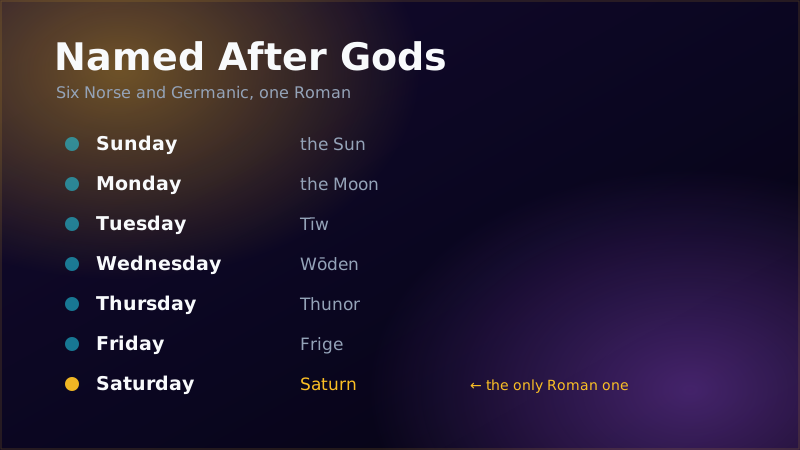
Four English days are named after Norse gods, two after the sun and moon, and one after a Roman. The full derivation, and why French and Spanish look so different.
English day names are a collision of two systems. The Romans named the days after the seven classical planets, which were themselves named after gods. When those names reached northern Europe, most of the Roman gods were swapped for their closest Germanic equivalent. One was not.
The seven
| Day | From | Who or what |
|---|---|---|
| Monday | Mōnandæg | The Moon |
| Tuesday | Tīwesdæg | Tīw, Norse Tyr, god of war and law |
| Wednesday | Wōdnesdæg | Wōden, Norse Odin |
| Thursday | Thunresdæg | Thunor, Norse Thor, god of thunder |
| Friday | Frīgedæg | Frige, linked to Frigg or Freyja |
| Saturday | Sæternesdæg | Saturn — the one Roman name kept |
| Sunday | Sunnandæg | The Sun |
Why the swap works so neatly
Line the English names up against the Roman ones and the logic appears:
| Roman | Germanic stand-in | Shared role |
|---|---|---|
| Mars (martis) | Tīw / Tyr | War |
| Mercury (mercurii) | Wōden / Odin | Travel, cunning, the dead |
| Jupiter (iovis) | Thunor / Thor | Thunder, the sky |
| Venus (veneris) | Frige | Love |
This is why French keeps the Roman originals almost intact: mardi, mercredi, jeudi, vendredi. Spanish and Italian do the same. English went through a Norse filter; the Romance languages did not.
The two ends of the week
French, Spanish and Italian replaced Sunday with a Christian name — dimanche, domingo, domenica, all from dies Dominicus, the Lord’s day — and Saturday with words derived from Sabbath: samedi, sábado. English kept the older pagan names at both ends.
Why seven at all?
The seven-day week has no astronomical basis. It comes from Babylonian astronomy, which tracked seven moving objects in the sky — the Sun, the Moon, Mercury, Venus, Mars, Jupiter and Saturn — and was reinforced by the Jewish Sabbath cycle. The Romans used an eight-day market week before adopting the seven-day one in the first century AD.
It has been attacked since. The French Revolutionary calendar tried ten-day weeks, and the Soviet Union experimented with five and six-day cycles in the 1930s. Both were abandoned.
For quizzes
- Which day is named after a Roman god in English? Saturday, and only Saturday.
- Which Norse god gives us Wednesday? Odin, as Wōden.
- Which two are named after things rather than gods? Sunday and Monday.