
Facts & Curiosities
How Long Things Really Take
Published October 22, 2026 • 1 Views
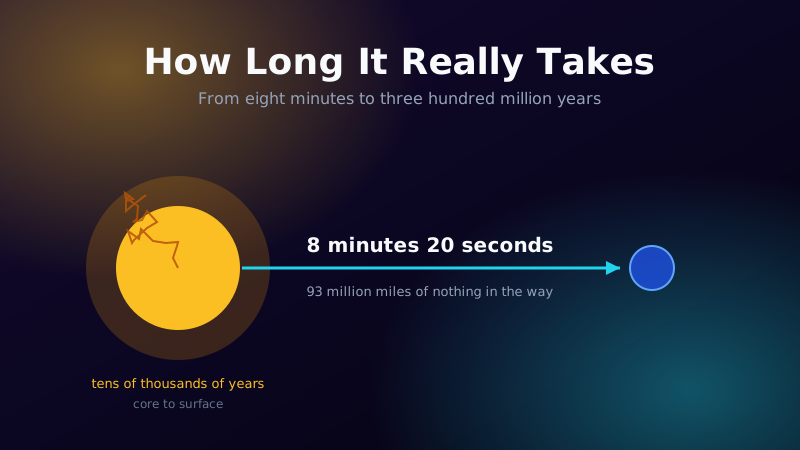
Sunlight takes eight minutes to reach you but thousands of years to escape the Sun, and a plastic bottle outlasts everyone who has ever drunk from it.
Some of these are much shorter than people guess, and some are much longer.
Light and distance
| Journey | Time |
|---|---|
| Sun to Earth, as light | 8 minutes 20 seconds |
| Sun's core to its surface, as energy | tens of thousands of years |
| Earth to the Moon, as light | 1.3 seconds |
| Earth to Mars, as a radio signal | 3 to 22 minutes |
| Nearest star (Proxima Centauri), as light | 4.2 years |
| Voyager 1 to the nearest star, at its current speed | about 70,000 years |
The second row is the surprising one. A photon leaving the Sun's core is absorbed and re-emitted so many times that the energy takes an age to work its way out — and then crosses 93 million miles of empty space in eight minutes.
Around the solar system
- A day on Jupiter: about 10 hours. It is the largest planet and the fastest spinning.
- A year on Neptune: about 165 Earth years. It has completed one orbit since its discovery in 1846.
- A day on Mercury: about 59 Earth days.
Things on Earth
- A red blood cell makes a full circuit of your body in about 60 seconds.
- Hair grows roughly 1.25 cm a month, so a shoulder-length head of hair is two or three years old at the ends.
- A human fingernail takes about six months to grow out from base to tip; a toenail takes 12 to 18.
- Your skeleton replaces itself gradually; the adult skeleton turns over roughly every ten years.
- A banana skin composts in a few weeks. A plastic bottle is estimated at around 450 years, and a glass bottle has no realistic figure at all.
- A sneeze leaves at around 100 mph; a cough at about 50.
Long odds on long times
- Coal that fuelled the Industrial Revolution formed around 300 million years ago, which is why the period is called the Carboniferous.
- The helium in a party balloon was made in stars, apart from the primordial fraction that has been around since minutes after the Big Bang.
- The gold in a wedding ring was almost certainly forged in a neutron star collision, and is older than the solar system.