
How Leap Years Actually Work
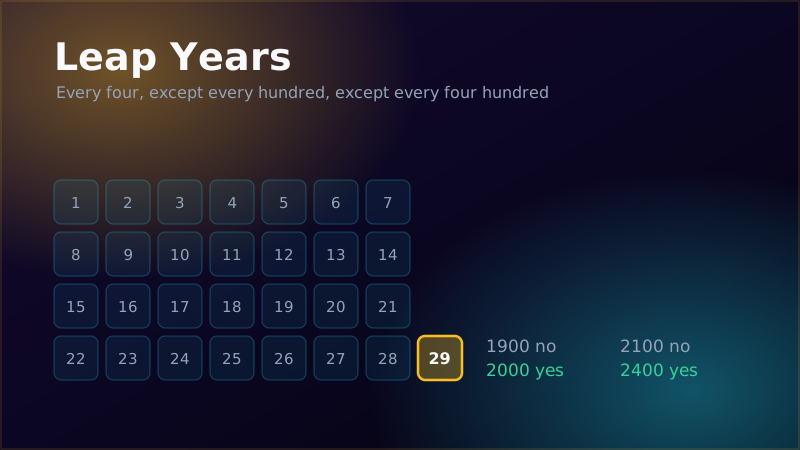
Every four years, except every hundred, except every four hundred. Why 1900 was not a leap year and 2000 was, and what the extra day is correcting.
Most people know leap years come every four years. Fewer know about the two exceptions, which is exactly why they make good quiz questions.
The problem being solved
A year is not a whole number of days. The Earth takes about 365.2422 days to go round the Sun. A calendar of 365 days therefore runs fast by just under a quarter of a day a year.
Left alone, that drifts. After a century the calendar would be 24 days out; after 750 years, midsummer would fall in what the calendar called spring. For an agricultural society, and for a church fixing Easter against the spring equinox, that is a real problem.
The Julian fix, and why it overcorrected
Julius Caesar’s calendar of 45 BC added one day every four years, treating the year as exactly 365.25 days. That is close, but it is 11 minutes and 14 seconds too long. Small, but it accumulates: about one day every 128 years. By the 1500s the calendar had drifted ten days from the seasons.
The Gregorian rule
In 1582 Pope Gregory XIII’s reform added two exceptions. A year is a leap year if:
- It is divisible by 4, unless
- it is divisible by 100, unless
- it is also divisible by 400.
| Year | Leap? | Why |
|---|---|---|
| 2024 | Yes | Divisible by 4 |
| 1900 | No | Divisible by 100, not by 400 |
| 2000 | Yes | Divisible by 400 |
| 2100 | No | Divisible by 100, not by 400 |
This drops three leap days every four centuries, giving an average year of 365.2425 days — within about 27 seconds of the truth, or one day’s error in roughly 3,200 years.
The ten days that never happened
Catholic countries adopted the new calendar in October 1582, skipping from the 4th straight to the 15th. Protestant and Orthodox countries held out for a long time. Britain and its colonies did not switch until 1752, by which point eleven days had to be dropped: 2 September was followed by 14 September. Russia changed only after the 1917 revolution, which is why the October Revolution is commemorated in November.
Worth knowing
- 29 February birthdays affect roughly one person in 1,461.
- Leap seconds are a separate thing entirely, added irregularly to account for the slowing of Earth’s rotation, not its orbit. A decision has been taken to stop using them by 2035.
- The leap year tradition of women proposing on 29 February is a 19th-century invention with a fake Irish backstory attached.
- 1712 in Sweden had a 30 February. Sweden botched a gradual transition between calendars, then reverted by adding an extra day. It is the only time that date has existed.