
Seven Experiments That Have Been Running for Over Fifty Years
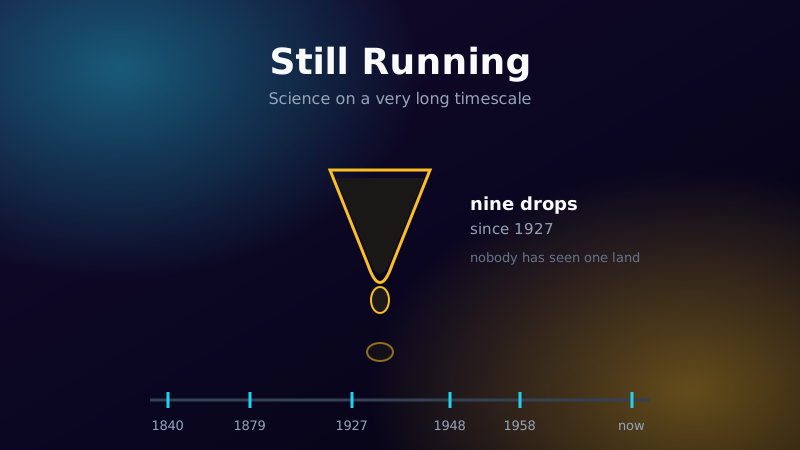
A bell that has rung since 1840, a tar drip that has produced nine drops since 1927, and a seed study whose jars are dug up by scientists who were not born when it started.
Science usually works in grant cycles of three years. These do not.
The Oxford Electric Bell — since 1840
A small brass bell in a laboratory at Oxford has been ringing roughly twice a second since about 1840, driven by two dry piles whose exact composition nobody knows, because opening them to find out would end the experiment. It sits under two glass domes, largely so people can get on with their work. It has rung an estimated ten billion times.
Beal's seed viability experiment — since 1879
William Beal buried 20 bottles of seed on the Michigan State campus, each holding 50 seeds of 23 species, to find out how long they stayed able to germinate. One bottle is dug up on a schedule and planted. The experiment has outlived Beal by more than a century, and in the 2021 dig moth mullein still came up — from seed buried before the invention of the aeroplane.
The Rothamsted Park Grass Experiment — since 1856
A field in Hertfordshire has been divided into strips, each given a different fertiliser treatment every year since 1856. It has quietly become the longest-running ecological experiment in the world, and because the samples were archived, researchers can measure things nobody in 1856 had heard of — including nitrogen pollution and the effect of acid rain.
The pitch drop — since 1927
Professor Thomas Parnell poured hot pitch into a funnel at the University of Queensland to show students that something that shatters like glass when you hit it is actually a very slow liquid. He let it settle for three years, then cut the stem in 1930. A drop falls about once a decade. Nine have fallen. No one has ever seen one land — the custodian who watched it for 52 years missed all of them, including one he lost to a camera malfunction in 2000.
The Framingham Heart Study — since 1948
Over 5,000 adults in Framingham, Massachusetts, agreed to be examined every couple of years for life. Their children joined in 1971, their grandchildren in 2002. Almost everything the public hears about heart disease — that smoking, blood pressure and cholesterol matter, and roughly how much — traces back to this one town.
The Harvard Study of Adult Development — since 1938
Two groups of young men, one from Harvard and one from poor districts of Boston, have been followed ever since, through careers, marriages, drink and illness. Its most-quoted finding is unfashionably simple: the strength of someone's relationships at 50 predicted their health at 80 better than their cholesterol did.
The Keeling curve — since 1958
Charles David Keeling began measuring carbon dioxide at Mauna Loa in Hawaii in 1958, and the instruments have not stopped. The resulting graph — a rising line with an annual zigzag as the northern hemisphere's plants breathe in and out — is probably the most consequential single dataset in science. It started at 315 parts per million.